Solving Behavior Problems with Functional Assessments: A Systematic Guide
Addressing complex behavior problems can be challenging for trainers and clients alike. Every individual animal and environment presents unique variables, and attempting to resolve an issue through trial and error often leads to frustration.
To create effective, long-lasting behavior change, trainers need an objective way to understand why a behavior occurs in the first place. This is where a functional assessment becomes an essential tool.
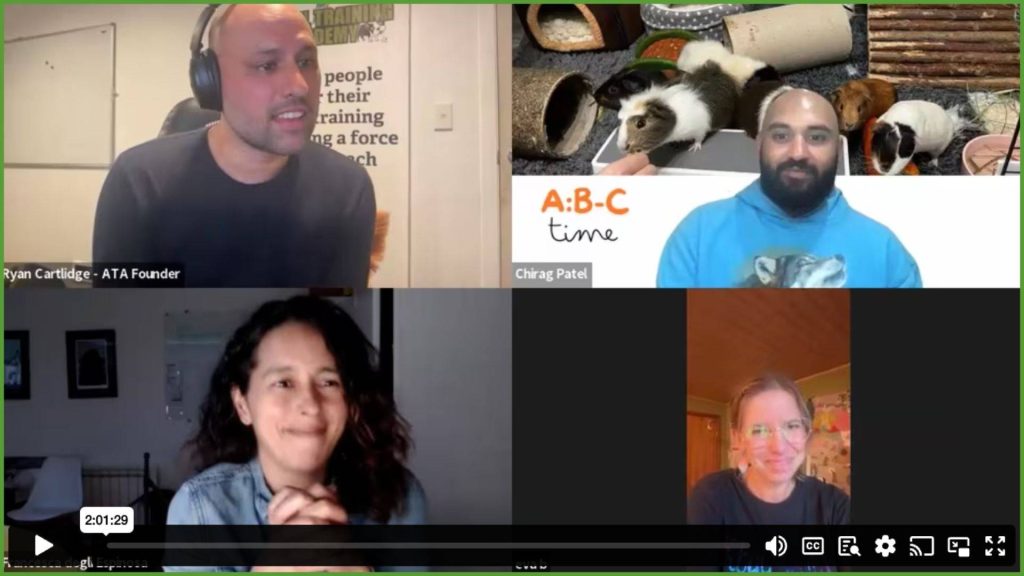
Recently, the Animal Training Academy hosted a panel discussion on this topic featuring three experienced professionals in the fields of animal training and Applied Behavior Analysis (ABA):
Chirag Patel: Behavior consultant specializing in the practical application of behavior analysis in animal training.
Eva Bertilsson: Positive reinforcement educator with over 30 years of experience and board member of the Swedish Behavior Analysis Association.
Francesca Espinosa: Board Certified Behavior Analyst working with humans with complex needs, bringing insights from human applied behavior analysis.
Below is an overview of what functional assessments involve and how you can begin applying them to your training cases.
What is a Functional Assessment?
In Applied Behavior Analysis (ABA), a functional assessment evaluates the purpose – or function – of a behavior by looking at the environmental context surrounding it. Rather than labeling an animal with terms like “stubborn” or “dominant,” a functional assessment examines the Antecedent-Behavior-Consequence (ABC) contingency:
Antecedent (A): The environmental conditions and triggers present right before the behavior occurs.
Behavior (B): The specific, observable action the animal performs.
Consequence (C): What happens immediately after the behavior that either reinforces or discourages it.
By identifying the conditions that trigger the behavior and the consequences that maintain it, trainers can target root causes rather than simply managing symptoms.
6 Practical Steps for Conducting a Functional Assessment
When addressing an unwanted or challenging behavior, follow these six steps to gather data and build a targeted intervention plan:
- Identify the Specific Behavior: Clearly define the specific behavior you want to assess.
- Gather Data: Observe and record when and where the behavior occurs, and what happens before and after [Antecedents and Consequences].
- Analyse the Data: Look for patterns and identify the possible functions of the behavior.
- Develop a Plan: Create a behavior intervention plan based on your analysis.
- Implement the Plan: Consistently apply the intervention and monitor progress.
- Review and Adjust: Regularly review the effectiveness of the intervention and make necessary adjustments.
Recommended Tools and Further Learning
Conducting functional assessments allows trainers to move away from guesswork, leading to more humane, predictable, and effective outcomes.
To explore functional assessments further, consider the following resources:
Dr. Susan Friedman’s FAID Form: A widely used, free framework for conducting functional assessments is Dr. Susan Friedman’s Functional Assessment and Intervention Design (FAID) form. You can learn more about how to use this tool by listening to our podcast episode with Dr. Friedman HERE
Watch the Full Panel Discussion: Members of the Animal Training Academy can view the complete webinar replay featuring Chirag Patel, Eva Bertilsson, and Francesca Espinosa. Become a member today. Click HERE
Browse Free Podcast Episodes: Explore over 280+ free episodes of the ATA podcast covering behavioral science, training mechanics, and ethics HERE
Comments on Solving Behavior Problems with Functional Assessments: A Systematic Guide
Identify the Specific Behavior: Clearly define the specific behavior you want to assess.
This is the thing. Does anyone have like a questionaire for digging up the specific behaviour?
And the Antecedents? Because this is where I fail the hardest.
Like when a dog “randomly” attacks their owner and bite them. The behaviour desribed is too unspecific, and “randomly”… it is never. And this is when I tend to go to explanations like pain or unfulfilled behaviour needs (enrichment and so on), because I don’t see the A. Help?
Hey Jenny thanks for your question and for sharing this challenge!
And my favourite form is Susan Friedman’s FAID >>> https://atamember.com/2023/05/08/function-assessments/
Have you seen and used this one by chance.
Also Susan and I did a podcast episode on when we talked a little bit about what to do when you get stuck doing our FA’s. Here’s the link to that one >>> https://open.spotify.com/episode/5OpdDwDhEuGoC4JRCBQgrI
As well as obviously the webinar replay above which you have access to!
And I also just want to add I think exploring the possibility of pain and any unmet needs is a great place to start and fitting for the situation you described!
Can a behavior intervention be positive ?? I’m thinking of my dog barking at any activity outside my house . She sees it , barks, it goes away . A bark collar would be a negative reinforcement. I don’t wanna do that. If I had a manners minder, and it went off every time she started to bark that would be a positive reinforcement which I’m calling an interruption. . . But would I it be just rewarding the bark.?
Joy the Pet Tutor can be used to reinforcing increased periods of silence.
Check out this episode of our podcast were we talk about this here >>> https://www.youtube.com/watch?v=RUy6CvUkZfM
Hope this helps.