Stimulus Control: A Five-Step Process ... 🐾
Previously at the Animal Training Academy, we were incredibly fortunate to host Norwegian dog trainer Morten Egtvedt, who taught us about fluency, shaping, and stimulus control. This week, I’m thrilled to share some of that knowledge with you. Establishing Good Stimulus Control: A Five-Step Process
learn more from Morten about Fluency, Shaping & Stimulus Control in this previous free podcast episode here >>> LISTEN to the podcast
Key Concepts;
- Cue (Discriminative Stimulus, SD): A signal that increases the likelihood of a specific behaviour. It signifies a stimulus that, when present, makes a particular behaviour more probable.
- Stimulus Control: The condition where a behaviour is influenced by the presence of a cue. It represents a basic level of control where the cue affects the behaviour’s occurrence.
- Full Stimulus Control: Achieved when a behaviour is under the complete influence of a cue, characterised by:
- Consistency: The behaviour is always performed in response to the cue.
- Exclusivity: The behaviour is not performed in the absence of the cue.
- Specificity: No other behaviours are performed in response to this specific cue.
- Fake Cue [non-relevant stimuli]: A deliberately introduced non-relevant stimuli used to teach discrimination between the actual cue and other stimuli. While “fake cue” might not be a standard term used in behaviour analysis or animal training literature, the concept of introducing non-relevant stimuli to test or strengthen stimulus control is a recognised training strategy. It’s akin to what might be described as “proofing” in dog training, where a dog is taught to ignore irrelevant stimuli and respond only to specific cues.
Establishing Good Stimulus Control: A Five-Step Process
Step Zero: Preparing for Precision
Objective: Attain fluency in the voluntary behaviour without any cues [see last weeks email for more info].
Precision: Ensure the behaviour is performed with 90-95% precision before introducing any cues.
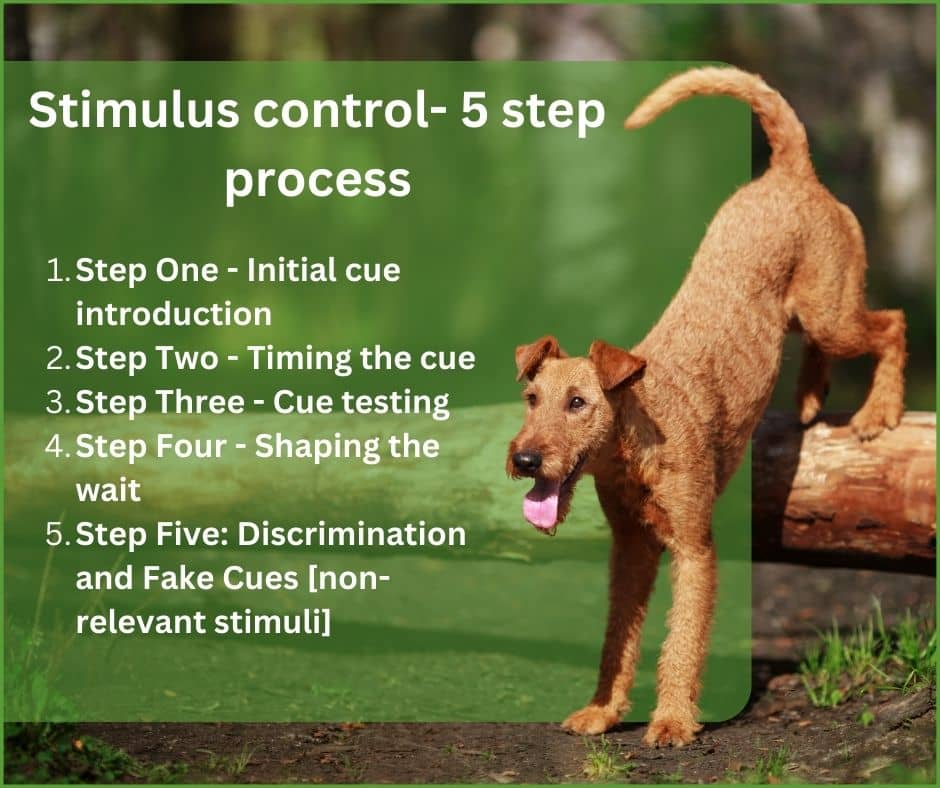
- Step One: Initial Cue Introduction
- Action: Start incorporating the cue as the animal begins to offer the behaviour voluntarily.
- Step Two: Timing the Cue
- Action: Introduce the cue precisely as the animal is about to initiate the behaviour.
- Step Three: Cue Testing
- Action: Test the cue’s effectiveness by presenting it before the animal starts the behaviour.
- Consideration: If the animal offers the behaviour before the cue, still provide reinforcement to maintain engagement.
- Step Four: Shaping the Wait
- Action: Shape the animal to anticipate the cue, reinforcing the pause before the cue is given, then rewarding the behaviour.
- Goal: Develop a clear expectation for the cue before the behaviour is performed.
- Step Five: Discrimination and Fake Cues [non-relevant stimuli]
- Action: Teach the animal to distinguish the specific cue from others, incorporating ‘fake cues’ to enhance focus on the actual cue.
- Strategy for Frustration: Start with one fake cue [non-relevant stimuli], followed by the correct cue in subsequent trials, gradually increasing complexity. Ensure to reset gently if needed.
If you’re ready to dive deeper into the science behind these strategies, I highly recommend checking out the full podcast episode with Morten Egtvedt. It’s packed with insights that will help you take your training from ‘good’ to ‘world-class.’ Click HERE