Shaping is one of the most powerful tools in our positive reinforcement training toolkit. However, knowing how to break a complex behavior down into clean, achievable steps can often feel challenging. When criteria are split poorly or raised too quickly, both the animal and the trainer can quickly become frustrated.
Understanding the mechanics of shaping – and learning how to design an effective shaping plan – can remove much of that guesswork.
To explore this topic, we welcomed behavior analyst Mary Hunter for a session on writing shaping plans. Mary holds a Master’s degree in Behavior Analysis and serves as an adjunct instructor in the Department of Behavior Analysis at the University of North Texas. Below are two key conceptual shifts Mary shares to help trainers approach shaping more systematically.
Defining the Terms
Before diving into training plans, it is helpful to revisit two core definitions:
Shaping: Teaching a learner a new behavior by using positive reinforcement to systematically reinforce successive approximations toward a target goal.
Successive Approximations: Small, reinforceable variations in behavior that start with actions the learner already performs and gradually progress toward the final desired behavior.
Mary described how she views shaping in her work with human and animal learners:
"Instead of thinking about shaping as going from nothing to something, I want you to think about shaping as going from something to something else. From this perspective, you can also think about it as going from old behaviour to new behaviour. Even if you have a learner that doesn't have a whole lot of training history, the learner has all sorts of things that they already know and things they can already do and things that they do in certain situations or certain settings. So we can look for that stuff and take advantage of old behaviour and things the learner already knows how to do. That makes shaping a lot easier.”
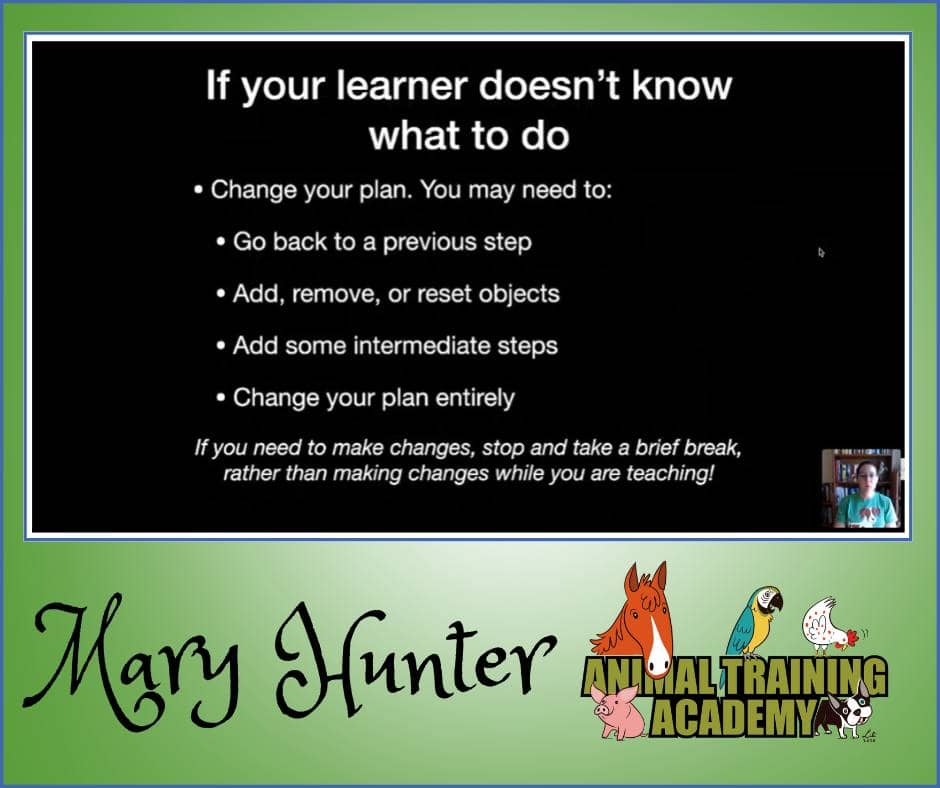
Mary also talked about the importance of having a plan for when your learner can’t figure out what to do:
“When your learner doesn't know what to do [&] when you get stuck, you need to change your plan. We don't want to leave the learner in a situation where the learner's continues to guess and get frustrated. So the important thing here is if you need to make changes, especially if you're making major changes, it's always good to stop and take a brief break and to think about what you're doing rather than trying to make changes while you're teaching.”